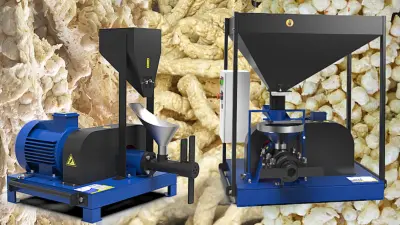
An extruder is a machine that uses pressure and high temperature to turn grain and other ingredients into a uniform, easily digestible feed. Below we explain how it is built and how it works, what problems it solves on a farm and what to look for when choosing one.
What an Extruder Is and How It Works
The most common type is the screw extruder, so this article focuses on it. A screw rotates inside the barrel and moves the grain along the chamber. On the way, the raw material is compressed, heated to about 180 °C and acquires the required consistency and uniformity.
How the Extruder Came About
A hundred years ago, farmers in America, Germany and England were looking for a machine that would decontaminate grain and make it as nutritious and digestible as possible. Extrusion first appeared in industry: machines softened material and shaped it, for example to coat electrical wires with insulation. Because the material underwent heat treatment, the idea arose of applying the same principle in agriculture, where grain constantly suffers from fungus and pests. Since the mid-20th century, feed extruders have been used successfully in livestock farming and the agro-industrial sector, as well as in the food and light industries.
Design of a Feed Extruder
A feed extruder consists of the following parts:
- barrel;
- working unit (screw, piston or disc);
- raw material feed unit;
- drive;
- interchangeable nozzles and dies that shape the mass;
- monitoring and control devices.
Grain Extruder: What Problems It Solves
Grain extruders have won over farmers, entrepreneurs and owners of small farmsteads, because they help solve several problems:
- decontaminate grain and reduce microbial load, including on grain with mold (heavily mold-damaged raw material should not be used, since extrusion does not remove mycotoxins);
- produce feed that, according to manufacturers, animals digest far better than raw grain;
- prepare feed for different species of animals and poultry;
- make storage easier and reduce feed waste;
- help cut the cost of buying raw materials.
The extruder accepts grain of different fraction and hardness: millet, wheat, corn, rye, oats and other crops. The raw material undergoes brief heat treatment at 110–180 °C, which kills most pathogenic microorganisms. Under heat and high pressure (up to several dozen atmospheres), an "explosion" occurs and the mass puffs up. At the exit it cools and sets in the shape defined by special perforated nozzles.
Efficiency: What You Can Expect
The figures below are indicative values reported by manufacturers and farms that use extruders. The actual result depends on the raw material, recipe, processing mode and animal species.
- Digestibility of extruded compound feed can reach 90–95%.
- The risk of gastrointestinal disease in animals can fall by a factor of 1.5–2.
- Productivity (milk yield, egg production) can rise by 20–40%.
- Spending on raw materials can be cut by 30–40% through better use of your own grain.
- Producing compound feed with a defined composition lets you start a small business of your own and sell surplus to other farms.
Which Animals an Extruder Suits
Extruders are bought for feeding cows, horses, goats and sheep, rabbits, chickens, geese, ducks and turkeys. They are also used on less typical farms: ostrich farms, fish farms and fur farms. Manufacturers supply extruders with interchangeable nozzles with openings of different diameters, so a farmer can swap the die and start making feed for another species.
How Extrusion Changes the Composition of Feed
- starch is broken down into simple sugars;
- many nutrients become more available, although some heat-sensitive vitamins are destroyed, which is why they are usually added after processing;
- husks and coarse fibers of cereals are digested better, which benefits the digestive tract.
Which Extruder to Choose for a Small Farm
If you have a small business or a homestead with several species of animals, you do not need a bulky machine. A mini extruder is enough: it fits in a utility room or garage and does not need complex preparation or several operators.
A versatile option is the extruder-pelletizer. Thanks to interchangeable working units, it can produce both pelleted and extruded compound feed.
When choosing a grain extruder, pay attention to these characteristics:
- motor power: from 4 to 18.5 kW;
- capacity: from 30 to 200 kg/h;
- a set of nozzles for making sticks and flakes;
- screw diameter: 38–70 mm;
- frame dimensions.
Where to Buy an Extruder
To be sure of the quality and performance of the equipment, and to get a warranty and service, it is best to buy directly from the manufacturer, who also supplies original spare parts and consumables.
Conclusion
An extruder helps you get safer, more digestible and longer-lasting feed from your own grain. TechnoMashStroy manufactures compact and reliable extruders designed to reduce costs and increase farm profitability. Our specialists will help you choose a model for your volumes and animal species.
Frequently Asked Questions
- What is an extruder in simple terms?
It is a machine in which a screw compresses and heats grain, which then puffs up at the exit and takes the required shape. The result is a more hygienic, more digestible feed. - Which crops can be processed?
Millet, wheat, corn, rye, oats and other cereal crops of various fraction and hardness. - Does extrusion destroy mold and pests?
High temperature kills most microorganisms. It does not remove mycotoxins already formed in the grain, so heavily moldy grain must not be used. - What extruder does a small farm or homestead need?
A mini extruder of 4 kW and up is usually enough. If you need both pelleted and extruded feed, consider an extruder-pelletizer. - Can one extruded feed be used for different animals?
The recipe should be matched to the species and age of the animals. Interchangeable dies and nozzles let you make feed of different shapes and sizes for different species. - Why buy an extruder from the manufacturer?
It makes it easier to get a warranty, service, and original spare parts and consumables.