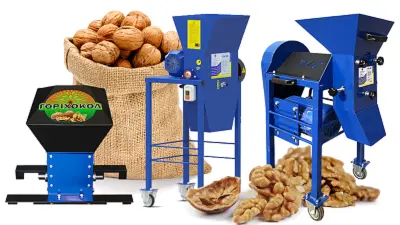
Walnut processing represents one of the most promising and financially attractive niches in small and medium-scale agribusiness. Thanks to favorable agro-climatic conditions and extensive orchards, vast quantities of walnuts are harvested annually. However, most local collectors still limit themselves to the simplest commercial model: purchasing in-shell round nuts from rural households and reselling them directly to major traders or exporters. This approach leaves the lion's share of added value in the hands of intermediate wholesalers.
The primary profit margin in this industry is concentrated directly at the primary processing stage — carefully separating the tender kernel from the hard outer shell, followed by precise sizing and sorting. The market price of clean, high-grade whole kernels is several times higher than that of raw in-shell nuts. Global and domestic markets demonstrate consistent demand for shelled walnut kernels, which serve as essential raw materials for confectionery, bakery, pharmaceutical, and cosmetic industries. Establishing a dedicated walnut cracking and sorting workshop requires reasonable startup capital, standard utility space without complex infrastructure, and delivers rapid payback when equipped with the right commercial machinery.
Why Walnut Processing Outperforms In-Shell Trading
The economic fundamentals of the walnut sector rely on the depth of raw material processing. Selling round nuts yields low profit margins due to intense competition among aggregators and heavy freight costs associated with bulky, heavy cargo. Conversely, marketable kernel meat delivers several clear commercial advantages:
- High Added Value: After controlled cracking and shell separation, the final price per kilogram of sorted product surges, easily absorbing operational overhead and leaving substantial net profit;
- Year-Round Market Demand: Shelled kernels are steadily procured by commercial bakeries, pastry manufacturers, snack packaging plants, and international trading companies fulfilling bulk export contracts;
- Compact Storage and Optimized Logistics: Clean kernel batches occupy considerably less warehouse volume compared to unshelled round nuts, cutting packing, warehousing, and transportation expenses;
- Diversified Revenue Streams: Processors can profit both from selling graded kernels and by offering contract mechanical cracking services to third-party aggregators at a fixed rate per processed kilogram.
The "Butterfly" Factor: Why Kernel Integrity Determines Profitability
The definitive pricing benchmark on the shelled walnut market is the percentage yield of intact "butterflies" (undamaged kernel halves, 1/2). The higher the proportion of whole halves in a finished lot, the higher the price per kilogram buyers are willing to pay.
Standard commercial grading segments the yield into distinct fractions:
- "Butterfly" (1/2 kernel): The most prestigious and expensive commercial grade, commanding peak demand on export markets and in premium confectionery packaging;
- "Quarters" (1/4 kernel): A highly liquid fraction actively utilized by industrial bakeries and food manufacturers for inclusions and toppings;
- "Eighths" (1/8 kernel) and pieces: Utilized in nut fillings, spreads, sauces, and cooking pastes;
- Nut crumbs and meal: Sells at the lowest price point as a snack, yet provides outstanding feedstock for fine walnut flour or cold-pressed specialty nut oil.
Manual cracking using hand mallets or hand-held pliers is not only painstakingly slow, but also crushes brittle kernels, dramatically reducing the butterfly yield and turning premium product into cheap broken crumbs. For this reason, modern walnut cracking machines are engineered to crack the outer shell gently without damaging or deforming the internal kernel meat.
The Complete Walnut Processing Technology Workflow
Building a scalable, profitable processing business requires adherence to a disciplined processing workflow, as end-product grade depends directly on each preparation stage.
1. Harvesting and Inbound Raw Material Quality Control
Varieties featuring thin or medium shell thickness are ideal for mechanical shelling, as they crack smoothly under pressure. Sourcing wild, thick-shelled varieties with heavy internal woody septa is strongly discouraged; extracting intact halves from such nuts is nearly impossible and subjects mechanical components to excessive wear.
2. Drying and Moisture Content Management
Freshly harvested walnuts contain high moisture, which makes their woody shells ductile and leathery while the inner kernel remains soft. Attempting to crack wet nuts results in mashed paste rather than clean halves. Prior to cracking, all raw nuts must undergo natural or forced air drying. Optimum shell dryness ensures that the hull fractures cleanly under mechanical compression, releasing the kernel intact.
3. Pre-Calibration and Size Grading
Size grading is the fundamental secret to maximizing the butterfly yield. Feeding uncalibrated batches into a cracking unit leads to large nuts being crushed into meal while smaller nuts pass through untouched. Segregating incoming stock by size is best accomplished using specialized vibratory or rotary grain cleaning and sorting equipment as well as industrial drum graders and calibrators. Calibrated batches enable operators to dial in the exact gap width, ensuring maximum preservation of intact halves.
4. Mechanical Shell Cracking
Calibrated nuts are loaded into the cracker hopper, where the shell is subjected to precisely measured compressive forces. Professional equipment features on-the-fly gap adjustments that do not require stopping the electric drive motor, maintaining uninterrupted production flow.
5. Kernel Separation, Sorting, and Dust Aspiration
Material exiting the cracking unit consists of a mixture of whole kernels, quarters, shell fragments, internal septa, and dust. Primary separation can be conducted on inspection sorting tables or motorized vibrating screens. To swiftly remove lightweight shell fragments, chaff, and dust, processors rely on industrial dust aspiration systems (dust extractors), which clean the kernels with high-velocity airflow and deliver clean, market-ready presentation.
6. Packaging and Storage
Clean walnut meat contains sensitive unsaturated oils prone to oxidation when exposed to sunlight, oxygen, and high humidity. To ensure extended shelf life without rancidity, sorted kernels are packed into food-grade cardboard boxes lined with parchment or sealed in vacuum barrier bags. Finished packages should be stored in cool, dark, dry, and well-ventilated storage rooms under stable temperature regimes.
Walnut Cracker Model Overview: Matching Machinery to Business Scale
Selecting the appropriate machinery depends on intended raw material throughput, available power supply, and shop space. Modern equipment lineups allow entrepreneurs to start small in a domestic setting and scale up to industrial output.
Compact Roller Walnut Cracker GRK-50: Affordable Entry-Level Solution
The GRK-50 is engineered specifically for beginners, home workshops, and small processing points. Its standout design advantage is independence from dedicated heavy motors: the main shaft is driven by a standard 850W+ hand drill with speed control set between 20 and 50 RPM (or an optional compact gear motor).
The GRK-50 features a sturdy mounting bracket designed to clamp directly over a standard collection bucket or bolt to a workbench. Operating throughput reaches up to 50 kg of raw nuts per hour, which matches the processing capacity of one or two workers sorting cracked nuts.
Electric Roller Nutcracker GRK-200: Reliable Commercial Workhorse
A heavy-duty, stationary machine designed for continuous daily duty cycles. The GRK-200 is powered by a dependable 1.1 kW electric motor running on single-phase 220V power, processing up to 200 kg of walnuts per hour.
The unit utilizes a proven roller crushing mechanism: incoming nuts are drawn into the serrated teeth of a rotating shaft and pressed against an adjustable anvil plate. Operators can fine-tune the clearance gap via an exterior hand adjustment lever while the motor is running. The frame includes front transport wheels, facilitating easy movement around the processing room or storage facility.
Conical Walnut Cracker GRK-300: Maximum Butterfly Yield and Versatility
A flagship processing machine designed to maximize high-grade butterfly kernel output. The unit uses a conical compression mechanism: the working chamber consists of two inclined cracking surfaces, one of which executes reciprocating action. As nuts enter the tapered chamber, they descend by gravity to the exact point corresponding to their diameter, receiving uniform, gentle compression from all sides.
This geometry avoids focal impact points, delivering unbroken kernel yields between 60% and 90% when processing pre-graded raw material. In addition to cracking up to 300 kg/h of walnuts, the GRK-300 excels at cracking hazelnuts (filberts) at rates up to 200 kg/h. The unit is fitted with an energy-efficient 0.75 kW motor available in 220V and 380V configurations.
Zero-Waste Production: Monetizing Shells and Processing By-Products
Maximum profitability in modern agro-processing comes from comprehensive by-product valorization. In walnut processing, virtually every fraction holds commercial value:
- Biomass Heating and Fuel Production: Crushed walnut shells possess dense structure, minimal ash content, and exceptional calorific value exceeding hard oak firewood. Broken shell fragments serve as outstanding solid fuel for automated heating plants equipped with pellet burners, providing cost-effective heat for processing workshops and drying chambers;
- Valuable Oil Extraction from Undersized Kernels: Broken pieces, small crumbs, and dark kernels should not be discarded at scrap prices. Installing heavy-duty oil screw presses allows producers to cold-press virgin walnut oil (prized in culinary and cosmetic sectors) while generating protein-rich walnut press cake for livestock feed formulas;
- Medicinal Internal Septa: The inner woody membranes contain high levels of natural iodine, tannins, and antioxidants, and are consistently sought after by herbal, pharmaceutical, and tincture manufacturers;
- Bulk By-Product Storage: For clean, weather-protected bulk storage of crushed shells, dried nuts, or expeller meal, farms deploy weatherproof galvanized storage silos that prevent moisture uptake and pest infestation.
Workstation Setup, Maintenance Schedule, and Operational Safety
Ensuring long equipment lifespans and continuous production requires routine technical service and strict adherence to workplace safety regulations.
Standard Maintenance Protocol
- Pre-Shift Inspection: Check all fasteners, verify motor and drive mounts, and inspect the hopper interior to confirm it is clear of foreign metallic objects;
- Daily Cleaning: Remove residual dust, oily residues, and trapped shell fragments from working plates, rollers, and discharge trays at the end of each work shift;
- Bearing Lubrication: Every 240 operating hours (or after every 300 kg of processed nuts), inject fresh grease (such as Lithol-24) into the bearing housings via the grease fittings;
- Off-Season Storage: If the equipment is idle for longer than two months, clean all bare metal surfaces, apply a thin coat of rust-preventive oil, and store the machine under a dust cover in a dry, ventilated room.
Workplace Safety Guidelines
Because mechanical nutcrackers feature moving components operating under compression, operators must strictly follow safety rules:
- Never reach into the loading hopper or use hand tools to force jammed nuts through the mechanism while the drive is active;
- The workstation floor must remain level, clean, and dry, outfitted with a wooden slatted platform to prevent slipping and improve electrical insulation;
- Electrical supply must route through dedicated circuit breakers and residual current devices (RCD) with a verified equipment ground;
- Operators must wear close-fitting workwear with secured cuffs; long hair must be tied and secured beneath protective headgear to prevent entanglement in rotating shafts;
- Personnel must wear safety glasses or face shields to safeguard eyes against flying shell splinters.
Walnut processing is a resilient, profitable sector offering vast growth potential. Starting with an accessible entry-level machine in a home garage, operators can systematically expand into a full-scale automated plant incorporating grading, gentle cracking, pneumatic separation, and by-product processing, securing strong market competitiveness domestically and internationally.