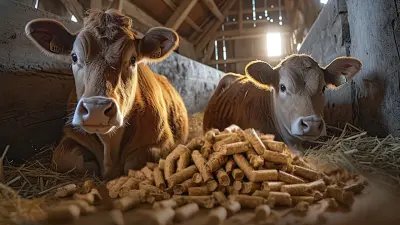
Feed pelleting is a process in which loose compound feed is turned into dense, uniform pellets under pressure and heat. For a farm, it is a way to cut feeding costs, reduce feed waste and keep quality under control. This article explains how the technology works, what a mini pelleting line consists of and how to calculate payback. As examples of equipment, we look at the GKM-100 and GKM-200 pellet mills from TechnoMashStroy.
How feed pelleting works: process stages
The process consists of several consecutive steps:
- Raw material preparation. Grain and meals are ground to the required particle size and screened, and the moisture of the mix is adjusted to 14–16% so the mass is plastic enough.
- Batching and mixing. Ingredients are weighed according to the formula and thoroughly blended so that every pellet has the same composition.
- Conditioning (if needed). The mix is treated with moist heat or steam, which improves pellet structure.
- Pressing. The mass passes through the die channels, is compacted and leaves as pellets of the set diameter.
- Cooling and drying. Pellet moisture is brought down to a safe 11–12%, which prevents condensation and microbial growth in the packaging.
- Screening and packing. Fines are separated and returned to the process, and finished pellets are packed.
During pressing the mix heats up, typically to 60–90 °C. This reduces the microbial and mold load, but it must be controlled: vitamins and enzymes are sensitive to overheating, so it is important to maintain optimal pressing force and correct raw material moisture.
Benefits of pelleted feed
Even intake. In a loose mix, animals pick the tastier components. In a pellet, all ingredients are bound together, so the ration stays balanced in protein, energy and minerals.
Less dust and waste. Pellets are easier to dose and are less likely to crumble or blow away during feeding and transport.
Higher bulk density. Pelleted feed takes up noticeably less space than loose mix: bulk density typically rises by a third or more. This simplifies storage and transport.
Better feed conversion. Thanks to starch gelatinization and less selective eating, digestibility improves. The size of the effect depends on the species and formula, so a realistic expectation is a few percent rather than a guaranteed result.
Longer shelf life. At 8–12% moisture and with proper packaging, pellets keep their quality much longer than loose mixes.
Flexible formulation. The recipe is easy to adjust for age, breed and production phase: starter, grower, finisher, lactation.
How much does on-farm pelleting save: a sample calculation
Suppose ready-made pellets cost UAH 5.5/kg on the market, while your own mix from the same ingredients costs UAH 2.5/kg. The difference is UAH 3 per kilogram. At 100 kg a day, that is UAH 300 per day, or about UAH 9,000 per month.
To estimate payback, divide the equipment cost by the monthly saving. Add electricity, labor and depreciation, as well as the cost of auxiliary units (grinder, mixer). Feed and raw material prices vary by region and season, so use your own numbers. Selling surplus to neighboring farms and local outlets brings additional income.
Feed pelleting equipment: GKM-100 and GKM-200 models
GKM-100 for small and growing farms
A compact model with simple pressure adjustment. The die can be changed quickly to the pellet diameter needed for poultry, rabbits or piglets. An energy-efficient drive helps reduce operating costs.
GKM-200 for medium and growing volumes
A reinforced model with stable feeding and a longer roller life. It can be supplemented with pre-conditioning (moist heat or steam) to improve pellet structure. Suitable for widening your product range and moving to semi-commercial feed production.
Technical features of both models
Optimized pressing force reduces overheating and helps preserve the vitamin profile. Reinforced bearing units reduce wear during continuous operation, and easy cleaning of working areas shortens downtime between batches. A flexible range of dies lets you choose the pellet diameter: roughly 2–4 mm for chicks, 4–6 mm for pigs, 6–8 mm for cattle.
A mini pelleting line: where to start
A full line includes grinding, precise weighing, mixing, conditioning (if needed), pressing, cooling, screening and packing. Its modular design lets you start with the core, a mixer and a pellet mill, and gradually add auxiliary units without changing the whole infrastructure.
What a feed formula is made of
A basic formula usually includes several groups of components: energy sources (corn, wheat, barley), protein (soybean and sunflower meal, legumes), fiber (bran, grass meal), vegetable oils to raise energy density, a mineral block (phosphate, salt), vitamin premixes, enzymes and organic acids. Exact proportions depend on species, age and productivity, so the formula should be agreed with a zootechnician or nutritionist.
Practical operating tips
- Monitor the moisture of the incoming mix: it affects pellet brittleness and density.
- Ensure even feeding to avoid load peaks and protect the die and rollers.
- Inspect pressing surfaces periodically and replace worn parts on time: this reduces energy consumption.
- Keep a log of parameters (moisture, temperature, output) for further optimization.
- Cool pellets before packing to avoid condensation.
Pelleting as the basis of a business
Local production of specialized feeds for broilers, laying hens, rabbits, quail, piglets or high-yielding cows gives a competitive edge: freshness and a transparent composition. The range can be expanded with functional additives and seasonal formulas, for example anti-stress formulas for hot weather and higher-energy ones for winter. A quality pellet reduces returns and strengthens a supplier's reputation.
Frequently asked questions
Why is pelleted feed better than loose feed?
Animals cannot pick out individual components, there is less waste and dust, and the feed is denser and stores better. For most farms this means more predictable feeding costs.
What moisture is needed for pelleting?
The raw mix is usually brought to 14–16%, and after cooling the finished pellets should be at 11–12%.
Can one pellet mill make feed for different animals?
Yes, provided you change dies to the required pellet diameter and prepare separate formulas for each species.
Are vitamins destroyed during pelleting?
Partly, since the process involves heating. That is why heat-stable premix forms are used and temperature and pressing force are controlled.
Consultation and pellet mill selection
TechnoMashStroy specialists will help you choose a model for your volumes, recommend dies, estimate payback and suggest ways to reduce energy consumption. Learn more about the equipment in the feed pellet mills section. You can also write to support@mkukraine.com.ua.