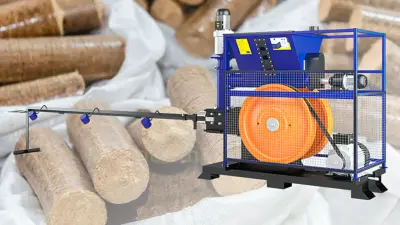
Transitioning to solid biomass fuel is one of the most effective ways to optimize heating expenditures for residential homes, greenhouses, production workshops, and municipal facilities. Among renewable energy sources, fuel briquettes manufactured by compressing dry wood particles, sawdust, wood shavings, sanding dust, and biomass residues occupy a premier position. However, heat yield and the longevity of heating equipment depend directly on fuel quality. To ensure uniform combustion, maximum heat output, and clean flue systems free from corrosive tar deposits, biofuel must comply with established Technical Specifications (TS).
Technical Specifications serve as the foundational regulatory standard governing physicochemical parameters of finished briquettes, raw material purity, testing methodologies, protective packaging, and plant occupational safety. For consumers, compliance with TS guarantees smokeless combustion with minimal soot, while for manufacturers, it defines the technological baseline and provides a passport to competitive wholesale and export markets.
Key Physicomechanical Quality Indicators of Premium Fuel Briquettes
Evaluating the commercial grade of densified biomass fuel relies on a set of laboratory and operational parameters that dictate combustion dynamics inside the firebox.
- Total moisture content (not exceeding 8–12%): Moisture is a decisive efficiency metric. When raw material is under-dried, a substantial portion of released thermal energy is wasted on evaporating water rather than heating the building. This causes boiler flue condensation, heavy creosote accumulation on heat exchangers, and acrid smoke. Conversely, excessively dry sawdust binds poorly during mechanical extrusion.
- Ash content (not exceeding 0.5–1.0% for pure wood): Ash content indicates the percentage of non-combustible mineral residue remaining after full combustion. Clean briquettes pressed from hardwood or softwood species leave a negligible ash bed, reducing boiler cleaning intervals to once every several days. Ash levels exceeding 1.5–2% indicate raw material contamination with sand, dirt, or excess bark, leading to glassy clinker formation on boiler grates.
- Product density (950 to 1200 kg/m³): Due to extreme compaction, quality fuel briquettes sink in water, significantly outperforming seasoned natural firewood in specific density. High density ensures a prolonged glowing coal phase and steady heat release, dramatically reducing boiler reload frequency.
- Net calorific value (not less than 4200–4500 kcal/kg): In heating value, high-grade briquettes closely rival bituminous coal and provide 1.5 to 2 times the heat of green split logs. One metric ton of dense briquettes replaces approximately four to five cubic meters of standard cordwood.
Raw Material Standards and Compression Technology
Classical wood fuel briquettes are produced from shredded wood: clean sawdust, fine wood shavings, sawmill trimmings, and joinery offcuts. A fundamental standard requirement is the total absence of artificial chemical binders or glues. Particle bonding occurs exclusively through lignin, a natural organic polymer present within plant cell walls. Under extreme mechanical pressure and temperatures exceeding 100 °C, lignin softens, plasticizes, and binds wood particles into an indivisible solid unit.
To ensure reliable, continuous extrusion, raw biomass must pass through an integrated preparation sequence:
- Primary and secondary milling: Raw material must have an even, fine fraction (1–3 mm). Slabs, edgings, and coarse branches are initially reduced using high-speed hammer mills, while agricultural residues and straw are prepared using dedicated grain, straw, and hay shredders.
- Deep biomass drying: Before entering the press, sawdust moisture is brought to nominal specifications using rotary drum or flash aerodynamic dryers.
- Foreign material separation: Biomass must be cleared of tramp metal, gravel, and abrasive soil using cleaning and sorting equipment to protect pressing dies and screws from rapid abrasive failure.
- Uniform feeding: Prepared material is metered into the compression chamber via sealed screw conveyors (precision augers) that maintain steady feed pressure without motor overload.
- Cooling and stabilization: Freshly pressed briquettes emerge hot and structurally pliable. To allow the polymerized lignin to solidify, units pass through calibrators and coolers that simultaneously separate loose fines.
Where processing plants aim to manufacture smaller-diameter wood pellets simultaneously, the production line incorporates heavy-duty Grand pellet mills, durable presses from the Pelletnik series, or complete modular pellet production lines.
Appearance, Structural Tolerances, and Geometry
Depending on the press mechanism employed, briquettes are shaped into cylindrical logs, hexagonal hollow profiles (Pini Kay), or rectangular brick forms (RUF). The natural color ranges from light golden yellow to deep roasted brown on heat-treated outer crusts.
Technical regulations allow minor superficial micro-cracks, light edge chipping, and slightly uneven end cuts. However, loose debris and broken pieces must not exceed 3–5% of total package weight. The presence of excessive bark, mold, rot, mineral oil stains, or visible chemical additives constitutes an immediate batch defect.
Batch Acceptance Rules and Laboratory Testing Protocols
Quality assurance is conducted on a batch basis by taking random representative samples from finished stacks or continuous conveyor flow. Each commercial lot is accompanied by a quality certificate documenting verified laboratory values.
- Moisture testing: Performed via the oven-dry method, where a crushed sample is dried at standardized temperatures until reaching constant weight, comparing mass differential before and after heating.
- Density verification: Determined by calculating the mathematical ratio between sample mass and geometric volume.
- Ash and calorific testing: Samples are incinerated in an oxygen bomb calorimeter to determine specific heat release and quantify the remaining mineral ash.
- Re-testing criteria: If any single test parameter fails to meet Technical Specifications, a double-sized sample is drawn from the same lot for re-testing. Secondary test results are binding for the entire shipment.
Occupational Safety and Plant Environmental Standards
Fuel briquettes themselves are completely eco-friendly, non-toxic, and hypoallergenic products that release no hazardous fumes during normal storage. Primary operational hazards arise during raw material processing and mechanical densification.
The predominant hazard is airborne dry wood dust. Inhaled dust irritates workers' respiratory tracts, while suspended dust clouds present severe explosion hazards. Consequently, milling, drying, and pressing zones must be equipped with forced-draft ventilation, and point sources of dust generation must be coupled with industrial dust extraction systems (aspiration).
All electrical panels, drive motors, and lighting in processing shops must feature dust-ignition-proof ratings, anti-static bonding, and verified earth grounding to prevent static spark discharges.
Storage Conditions, Packaging, and Transport Logistics
Dense briquettes remain hygroscopic: prolonged direct exposure to liquid water or humid ambient air causes them to reabsorb moisture, swell, lose structural density, and disintegrate back into loose sawdust. Strict storage and packaging compliance is vital to preserve heating performance.
- Protective packaging: Commercial packaging involves stacking 10–12 kg bundles sealed within airtight polyethylene shrink film to protect against rain and condensation. Bundles are palletized onto euro-pallets, bound with tension strapping, and stretch-wrapped.
- Transportation: Briquettes must be transported in covered vehicles (curtain-side trucks, closed dry freight vans, or boxcars).
- Warehouse storage: Palletized stock must be stored in dry, covered, well-ventilated warehouses with ambient relative humidity below 75–80%. Open-air ground storage is strictly prohibited. Intermediate supplies of dry sawdust and biomass residues are stored securely in weatherproof galvanized storage silos that guard against precipitation and rodents.
Maximizing Efficiency with Solid Biomass Fuel
Thanks to low ash content and uniform heat dissipation, briquettes perform exceptionally well across standard solid fuel boilers, heat-accumulating masonry heaters, cast-iron stoves, and fireplaces. They burn with a steady, translucent flame without sparking, maintaining a durable bed of coals that saves substantial firebox tending time.
In large-scale commercial heating systems requiring continuous fuel feeding alongside briquette boilers, automated pellet installations utilize standardized wood pellets fired through advanced pellet burners. Utilizing certified solid biofuel ensures high heating efficiency, shields boiler heat exchangers from corrosion, and delivers complete energy autonomy throughout the heating season.