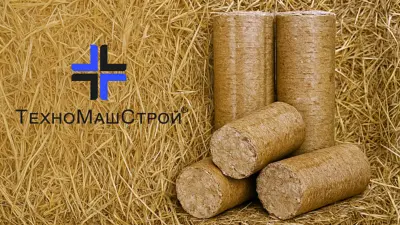
Gas, electricity and firewood get more expensive every year, and heating a private home or farm takes an ever larger share of the budget. At the same time, millions of tonnes of straw are left in Ukrainian fields after every harvest, and meadows and riverbanks offer plenty of hay, dry grass and reed. The BIOMASS briquette press from TechnoMashStroy turns this raw material into dense fuel briquettes, also known as euro firewood. You can burn them yourself or sell them.
Why straw briquettes are a real alternative to firewood
Dry straw has a calorific value of about 14–16 MJ/kg (roughly 4 kWh per kilogram), which is close to that of air-dried firewood. The problem is its bulk and how fast it burns: loose or baled, straw takes up a lot of space and burns too quickly. Under pressure it becomes a dense briquette with a moisture content of only 8–12%. Such a briquette burns evenly and for a long time, and takes up many times less storage space than the original raw material.
To put it in perspective: in terms of energy, one tonne of straw briquettes is roughly equivalent to 350–400 m³ of natural gas. For farmers, owners of large homesteads and small businesses, this is a way to cut heating costs significantly.
What raw materials the briquette press can process
BIOMASS works with readily available materials that usually cost nothing or very little: cereal straw, hay, dry grass and reed. No complicated preparation is needed. It is enough to shred the material and make sure it is dry: the optimal moisture content is up to 15%. As in Poland and other EU countries, where biofuel has long been a normal part of the energy mix, demand for it in Ukraine is growing along with tariffs.
How the BIOMASS briquette press works
The design is simple, so the machine is easy to operate and a single person can run it. The process consists of several consecutive stages:
- Shredded raw material is loaded into the hopper.
- The mixer feeds it evenly to the screw.
- Under pressure and heat, the mass is compacted.
- Special weights on the stabilizer let you adjust the hardness of the briquette.
- At the output you get a finished briquette 80 mm in diameter.
Why no glue or additives are needed
Briquettes hold their shape thanks to lignin, a natural substance found in plant material. Under heat and pressure it softens and then binds the particles together. As a result, the fuel consists of plant material only, with no binding additives.
Technical specifications
Key parameters of the BIOMASS briquette press from TechnoMashStroy:
- Capacity: up to 160 kg per hour;
- Briquette diameter: 80 mm;
- Power: 8.5 kW;
- Power consumption: up to 60 kWh per tonne of briquettes;
- Staffing: 1 operator;
- Dimensions: 610 × 81 × 220 cm.
Low energy consumption keeps the cost of a briquette to a minimum. The main cost items are shredding and, if the material needs it, drying.
Advantages of briquettes over ordinary firewood
Affordable raw material. Straw, hay and grass cost much less than timber, and can often be obtained for free.
Easy storage. Low moisture and high density allow briquettes to be stored for a long time without losing quality. They are easy to stack and transport.
Long burn time. A dense briquette burns more slowly and evenly than loose straw, so you do not have to add fuel as often.
Ash as fertilizer. Note that straw leaves more ash than wood does. However, it is rich in potassium, so it can be used to feed a vegetable garden or orchard. Also, check with your boiler manufacturer that the boiler is suitable for burning straw briquettes.
Environmental benefit. Burning stubble and dry grass in fields is prohibited in Ukraine and punishable by fines. Turning this waste into fuel lets you dispose of it legally and profitably.
A briquette press as the basis of your own business
BIOMASS produces up to 160 kg of briquettes per hour, which is over 1.2 tonnes per eight-hour shift. Working 22 shifts a month, you can produce about 28 tonnes of fuel. Buyers can include households, owners of cafés and greenhouses, farms and small boiler houses. Since the heating season in Ukraine is long and the European biofuel market is growing, euro firewood production has good potential. If you are a farmer, you also put your own production waste to use.
Frequently asked questions
- Can I heat an ordinary stove or fireplace with straw briquettes?
Yes, they are used in stoves, fireplaces and solid fuel boilers. For automatic boilers and complex systems, check the fuel requirements with the manufacturer. - How many people are needed to operate the briquette press?
One operator is enough. - Do I need to add glue or binders?
No, the briquette is formed thanks to the natural lignin in the plant material.
Order a BIOMASS briquette press
Want to cut your heating costs or start your own production? TechnoMashStroy specialists will help you choose a configuration, calculate payback and answer technical questions. For more information about the equipment, visit the website: briquette presses. You can also write to support@mkukraine.com.ua. Don't put it off: it is better to prepare in advance for the next heating season.