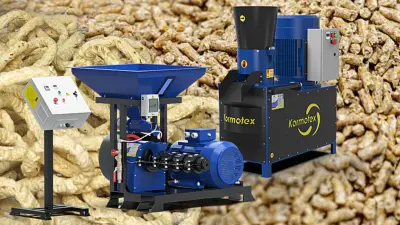
The choice between a feed extruder and a pellet mill depends on your goals: the type of livestock or poultry, production volume, raw materials and budget. Both machines are effective, and both extruded and pelleted feeds are in steady demand. To decide, let's look at how each machine works, what its strengths are and which tasks it suits best.
Grain Extruder: What It Is and How It Works
Meat productivity (carcass yield, tissue quality and overall carcass quality) is one of the key economic indicators in livestock farming. To raise it, farmers often turn to growth stimulants, but these can disrupt metabolism and lead to disease. A safer alternative is to use biologically active additives, balanced compound feeds and specially processed feeds. Extruders are used to make the latter.
The technology is about 60 years old, and extrusion is now widely used to produce feed for farm animals, poultry and fish.
The process takes only a few dozen seconds: screws compress the grain, temperature and pressure rise sharply, and at the exit the pressure drops, so the product "explodes" and expands into a porous structure.
Benefits of Extruded Feed
- Starch, which is poorly digestible in raw grain, is partially broken down into dextrins and simple sugars that are easy to digest.
- The finished feed is more nutritious and more palatable.
- Most nutrients are retained. Heat-sensitive vitamins, which may partly degrade, are usually added after processing.
- Low moisture content allows longer storage.
- High temperatures destroy most harmful bacteria and reduce the risk of infection.
Pellet Mill: What It Is and Why It Is Useful
Pelleting presses a ground mixture into dense pellets of uniform size. Thanks to this density, animals and poultry eat more feed per sitting, with less waste and dust. Pellets have an identical composition and shape, so animals cannot pick out the tastiest ingredients, and the ration stays balanced.
Pelleted feed usually costs a little more, which is explained by its advantages:
- it is easier to transport and takes up less space;
- it is more resistant to moisture, temperature changes and sunlight than loose mash feed.
Extruder vs Pellet Mill: Key Differences
- Processing method: an extruder uses high temperature and pressure; a pellet mill presses the mixture through a die, usually with added steam.
- Digestibility: it is generally higher after extrusion, because the starch is partially broken down.
- Hygiene: extrusion provides stronger heat treatment and decontamination.
- Storage and transport: both feed types keep longer than loose feed; pellets are especially convenient for logistics.
- Cost and energy use: a pellet mill is usually cheaper and more economical to run, while an extruder requires a larger investment.
How to Choose the Right Equipment
- Choose an extruder if you need maximum digestibility and decontamination: feed for young animals, fish and pets, or processing of legumes and starch-rich grain.
- Choose a pellet mill if you produce large volumes of complete feed for poultry, pigs or cattle and a low cost per ton matters.
- Combine both if you need flexibility: for example, extrude individual components and then pellet the finished compound feed.
Conclusion
There is no one-size-fits-all answer: an extruder wins on digestibility and feed safety, while a pellet mill wins on cost, throughput and logistics. Base your decision on your livestock, volumes and budget. The TechnoMashStroy catalog offers extruders and pellet mills for a range of capacities, and our specialists will help you choose a model for your production.
Frequently Asked Questions
- How does an extruder differ from a pellet mill?
An extruder processes grain under high pressure and temperature, changing its structure. A pellet mill simply presses the mixture into dense pellets, usually with milder heat treatment. - Which is more cost-effective for a small farm?
Most start with a pellet mill because it is cheaper and simpler to operate. If you feed young animals or produce fish feed, though, an extruder may justify the investment. - Are vitamins lost during extrusion?
Some heat-sensitive vitamins may degrade, so they are usually added after processing. Other nutrients are largely retained. - Can an extruder and a pellet mill be used together?
Yes. Many producers extrude individual components and then pellet the finished compound feed. - How long do extruded and pelleted feeds keep?
Under proper conditions they keep longer than loose compound feed: extrudates thanks to low moisture, pellets thanks to resistance to external factors.